
You logged off. Why does it still feel like you are working?
You logged off work, but your brain is determined to keep providing unpaid mental labor.
Maybe that labor looks like checking “just one more time” for a response or rereading the email you sent three hours ago. Maybe it leads to reopening that presentation for “just one more pass” now that you feel calmer and are away from the hustle and bustle of back-to-back meetings.
Meanwhile, your personal life is happening—and you are being pulled in a million different mental, emotional, and energetic directions. Day after day, the internal hamster wheel continues.
What would it be like to be more fully present for your kids, your spouse, your friends, your family, and, most importantly, YOURSELF when you are logged off work?
What would it feel like to be focused on work when actively engaged, and mentally “off the clock” when you’re not?
What would you give more attention to with that extra space? What might change for your loved ones? For your mental, emotional, and spiritual well-being? Even for the next workday?
For so many of us, the line between work and our personal lives blurred, and then disappeared completely. Technology made work only a notification away, and for those of us who began working from home, the workplace moved fully into our living space.
On top of that, transitions are challenging for many of us. Logging off work is—and should be—a transition, not a moment that disappears into the never-ending loop of thoughts and activities across your 24-hour day.
If any of this resonates, a focused and intentional logout routine is a small but meaningful change you can introduce into your day to begin flipping the script.
You don’t need an elaborate evening ritual or a color-coded shutdown spreadsheet. Start by creating a clear signal that the workday has ended: capture anything unfinished so your brain doesn’t have to keep holding it, identify the first thing you’ll return to tomorrow, and consciously acknowledge, “Work is finished for today.” The specific routine matters less than practicing a consistent transition that your mind begins to recognize.
It isn’t a magic wand or a panacea for complete mental freedom. But when practiced and refined consistently, a logout routine can help you experience more ease, a greater sense of control, and more freedom during your off hours.
I found so much power in this practice that I included it as one of the seven small shifts in my free 7-Day Work Survival Guide. It walks you through creating a transition that works for your actual life—not someone else’s perfectly curated evening.
Get the Free 7-Day Work Survival Guide →
If you want to explore what you’re carrying out of the workday more deeply, The Work Reset 30-Day Journal also includes end-of-day reflections designed to help you notice recurring patterns, release the day, and make more intentional choices about what comes home with you.
Explore The Work Reset 30-Day Journal →
Blog written by me. Image created by ChatGPT.

Behind the Curtain
Nothing filled the gap between "Keep going. It'll get better." and "Burn it all down and start over." So I created what I wish had existed for the women caught somewhere in between.
I suffered in silence long before I suffered out loud, and wow… did I suffer loudly and obviously by the end of that chapter. Everything I saw that might be able to help me was either some version of “Transform your life! Quit your job and chase your dreams!” or “How to manage your time or improve your performance!” Nothing I saw offered me peace in the place I was in at the moment. Nothing filled the gap between "Keep going. It'll get better." and "Burn it all down and start over." That’s the space I’m focused on now with my coaching. When you don’t want to keep experiencing another day like the last, but you aren’t ready to make a change, you can change the way you experience work and feel more like yourself again.
Early in my career, looking at high-performing women in meetings and offices around me, I marveled at their drive, poise, and “executive presence.” How do they do it? Will I ever have the inner calm, purpose, and general badassery of these women? As Ella Langley sings, I just wanted to “be her”, but the C-Suite version.
Then I climbed higher and saw behind the curtain. In my HR leadership roles, I was privileged to sit with women in their real feelings - their hopes, doubts, fears, and anger. To hold space for them during their hard moments and bare witness to their journeys.
Coming up in my career, we didn’t “bring our authentic selves to work”; we “left our personal lives at the door”. We didn’t have safe spaces and flex days, we “sucked it up buttercup”. We definitely didn’t cry in baseball….maybe in a bathroom stall or our cars at lunch, but only if we could hide the evidence well enough to say “it’s just allergies” before returning to our desk. I was driven, hungry, and fairly single-minded. I was a bit of a nightmare, to be honest. And I truly thought that what I saw on the outside represented the truth of who these women were and that I was the rare one struggling on the inside.
As the workplace evolved and I rose higher and faster through leadership levels, I learned that the women who seemed to have it all were often carrying more than anyone knew. It was much darker behind the curtain than I ever imagined. I became the safe space for women in my organizations who would walk out of my office and successfully pull off a high pressure meeting that made me leave sweat marks on my chair when it was over. I watched them cry on their first days back to work after maternity leave, when they didn’t get the promotion, when they GOT the promotion, and through every injustice they experienced in the workplace. Through surgeries, caregiving, death, and divorces…I’ve had the unique privilege of listening to and supporting women during my workdays somewhere between payroll issues and C-Suite temper tantrums; this was the invisible work I did that mattered most.
Then I pivoted into tech consulting. A true career 180. I went from HR leader to individual contributor. From being one of the most senior people in the room to feeling like I didn't even know the name of the pond I had just been dropped into.
It was my first time in years experiencing work primarily as an employee instead of an HR leader. I was no longer sitting behind closed doors hearing what was really going on. I wasn't the safe space people were sent to. I was navigating the same deadlines, expectations, politics, restructures, difficult leaders, and imposter syndrome everyone else was.
Consulting also gave me something HR never could: a front-row seat to company after company, team after team, and culture after culture. I worked alongside more highly paid, highly accomplished women than ever before. Women so polished and put together that my imposter syndrome reached heights I previously thought impossible.
I was no longer the HR person. I was just another employee.
And yet the women still found me.
And they shared.
“Oh, I cried every day the first 6 months I worked here.”
“I cry at least once a week.”
“Is it really consulting if you don’t cry weekly?”
These were the truths being shared with me regularly now. Even these women, who seemed to have it all, who didn’t struggle for survival, regularly had to release via tears to make it through their days or weeks. Woman after woman confided in me, most in a self-deprecating and joking way, others just as a matter of fact. “This is just how it is.”
Progress, I thought at first. This is progress! We can talk openly about it, we can now express ourselves freely at work, and my tears are okay. I’M IN THE CLUB. I’m validated. I don’t need to be ashamed of the way I feel and I’m not alone. And my suffering out loud increased in volume. That volume attracted others to share their real daily inner experience with me.
Nothing filled the gap between "Keep going. It'll get better." and "Burn it all down and start over."
Over the last 5 years, I’ve watched the stress at work catapult to levels I don’t remember experiencing in my lifetime. I’ve seen these amazing, badass women feel they have worn out and lost their spark. They question what is wrong with them, what is wrong with work, and sometimes what is wrong with the world. They wonder if this is all there is. They wonder if it was worth it. They don't feel they can leave. After all, they poured years, sometimes decades, into building the life they have now. They have kids that need their income, mortgages that need to be paid, business partners they’ve signed contracts with who won’t take a departure lightly and teams at work that depend on them. But the internal fire is dim, the questions are loud, and the path forward is murky.
Some have even stopped crying. They’ve accepted this is the way it is and focus on detaching, “caring less”, and figuring out how to put their time in until the magic day they can retire or do a vague “something else” that they don’t have time or energy to think about. Others are still hoping the next company will be less “toxic”, executive leadership will suddenly put humans ahead of boards and billables in real life and not just Townhall presentations, or the next boss will make it all bearable. What struck me wasn't the stress anymore. It was how many women no longer sounded like themselves.
Yes, it’s true that women have been experiencing this internal stress my entire career and it took me time to see it. But it is also true that almost every woman I’ve met in the past few years is sharing some version of “I’ve lost my mojo”, “I’m just putting in time”, “I can’t do anything else at this point so I just put one foot in front of the other”. In my lived experience, it's a downright epidemic.
So I’ve created what I needed all of those years ago. Yes, my coaching offers and tools are based on my knowledge and experience of everything from psychology through coaching through being an HR leader, but they are heavily inspired by and driven by my lived experience. My services are what I needed when I was suffering silently, before I started suffering out loud, and definitely before I became someone I didn’t recognize, and frankly didn’t like, anymore.
You are not alone. I promise you are not alone. And you don’t have to wait until burnout to change how you experience work. The next company, the next boss, the next tech disruption, the next restructure….you can feel better through it all.
I can't promise you'll never cry at work again.
I can't promise the next restructure won't happen.
I can't promise your boss will suddenly become enlightened.
But I can promise this:
You have more power than you think.
You can do more than survive.
And you can feel more like yourself again.
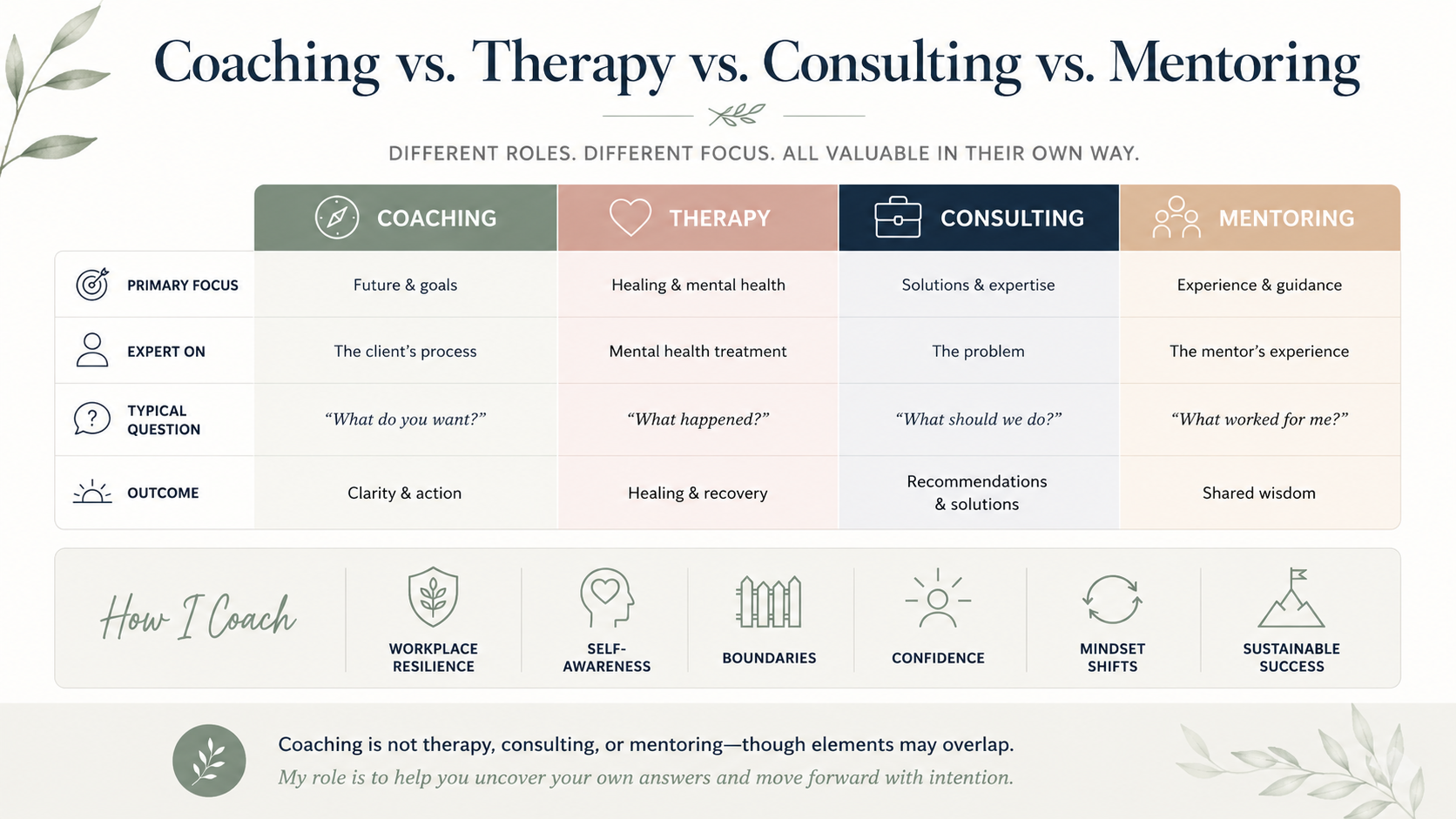
What Coaching Is (And What It Isn't)
Understanding the Differences Between Coaching, Therapy, Consulting, and Mentoring
The coaching industry can be confusing.
One person is helping clients process relationship patterns. Another is teaching a step-by-step business strategy. Someone else is sharing lessons from their own career experience. All of them might call themselves a coach.
So what exactly is coaching?
According to the International Coaching Federation (ICF), coaching is:
"Partnering with clients in a thought-provoking and creative process that inspires them to maximize their personal and professional potential."
At its core, coaching is a collaborative partnership. The coach is not there to diagnose, fix, direct, or provide all the answers. Instead, coaching helps clients increase awareness, challenge assumptions, uncover options, and move toward meaningful action.
But that often raises another question:
How is coaching different from therapy, consulting, or mentoring?
Coaching vs. Therapy
Therapy and coaching can sometimes explore similar topics, but they serve different purposes.
Therapy is focused on mental health, emotional healing, diagnosis, trauma recovery, and helping people address challenges that may be impacting their well-being. Licensed therapists are trained to assess and treat mental health conditions and provide clinical support.
Coaching is not mental health treatment. While we may discuss thoughts, beliefs, habits, or past experiences when they are relevant, the purpose is not diagnosis or treatment. The focus is helping clients increase awareness, gain clarity, identify obstacles, and move toward goals that matter to them.
The same topic may appear in both a coaching session and a therapy session. The difference is often the lens through which it is being explored and the role of the professional facilitating the conversation.
Both coaching and therapy can be incredibly valuable. Many people benefit from one, the other, or both at different times in their lives.
Coaching vs. Consulting
Consultants are hired for their expertise. When a consultant is brought into an organization, the expectation is usually that they will assess a situation, provide recommendations, solve problems, and tell the client what they believe should happen next. I've spent much of my career doing exactly that.
Coaching is different. In a coaching conversation, my role isn't to hand you my answers. It's to help you uncover yours. That doesn't mean I ignore my experience. It means I don't assume my path is the right path for you.
Consulting says:
"I have expertise that can help solve this problem."
Coaching says:
"You have more wisdom, insight, and capability than you may realize. Let's uncover it together."
Coaching vs. Mentoring
Mentoring sits somewhere in the middle. Mentors share lessons from their own experience and offer guidance based on what they've learned. For example, if someone asked me how to transition from HR into IT Project Management in consulting, I could absolutely mentor them because I've done it.
Coaching would look different. Rather than telling someone what I did, I'd help them explore their own goals, strengths, concerns, and options so they can make decisions that fit their circumstances.
Mentoring often sounds like:
"Here's what worked for me."
Coaching often sounds like:
"What feels most aligned for you?"
How I Coach
My coaching focuses on helping professionals who don't feel like themselves at work anymore.
Many of my clients aren't looking to leave their jobs tomorrow. They're trying to navigate a demanding workplace, difficult relationships, constant change, competing priorities, or the feeling that they've slowly lost themselves beneath the weight of it all.
That's where my work is different from traditional career coaching. I'm not focused on resume reviews, interview preparation, or helping you climb the corporate ladder faster. And while I bring 10 years of leadership, HR, consulting, and project management experience to our conversations, I don't approach coaching as consulting.
Instead, I help clients explore the thoughts, patterns, assumptions, habits, and workplace dynamics shaping their experience. Together, we identify what's within your control, challenge the stories that may no longer be serving you, strengthen self-awareness, reconnect with your values, and create practical ways to navigate work with more clarity, confidence, and intention.
Sometimes that means setting healthier boundaries and understanding how to actually hold to them. Sometimes it means approaching difficult conversations differently - do they even need to be “difficult”? Why? Sometimes it means recognizing that you've been carrying responsibility that was never yours to carry in the first place. And sometimes it means discovering that while your situation hasn't changed yet, your experience of it can.
That’s what I want for you - the power to change your work experience without changing your circumstances before you are ready. Because when we change how we relate to our circumstances, we often uncover possibilities that were hidden in plain sight.
My goal isn't to tell you what to do, it’s to help you hear yourself more clearly so you can decide what comes next.
When Coaching Isn't the Right Fit
Coaching can be a powerful tool for self-awareness, growth, decision-making, and goal achievement. However, there are situations where coaching is not the most appropriate form of support.
Coaching is not designed to diagnose or treat mental health conditions, process trauma, provide grief counseling, or address issues that require clinical assessment and treatment.
If a prospective client is seeking support for concerns that fall outside the scope of coaching, I believe they deserve the care of a qualified mental health professional with the appropriate training and licensure.
In some cases, individuals may benefit from both coaching and therapy, with each serving a different purpose.
My role as a coach is not to replace therapy.
My role is to provide a structured space for reflection, awareness, personal growth, and forward movement toward goals that matter to you.
So What Happens In Coaching?
Most people don't come to coaching because they need more information. They come because they're stuck and know something needs to change, but they can't quite see the path forward. Maybe they're overwhelmed at work. Maybe they're second-guessing themselves. Maybe they're struggling with boundaries, confidence, burnout, decision-making, or a major life transition.
Coaching creates space to slow down, think more clearly, challenge unhelpful patterns, reconnect with what matters, and move forward with greater intention. The goal isn't for the coach to become the expert on your life. The goal is for you to become more aware, more intentional, and more confident in navigating it yourself.
Expect your thinking to be challenged. Expect to set meaningful goals and be held accountable for the commitments you make to yourself. Most importantly, expect a supportive space where you can be honest about what's really going on and begin making intentional changes to how you experience your workday.
A Note About Coaching: Coaching is designed to support self-awareness, personal growth, goal achievement, and intentional change. It is not therapy, counseling, or mental health treatment. If I believe a client would be better served by a licensed mental health professional, I'll say so. My goal is always to help people find the right support for their need.